Road to a Real Mechanical Engineer

Projects
My Thrilled Past Experience

Advanced Control Project: Space X Rocket Launch Control with and without Grid Fin
Sep. 2019 - Dec. 2019
Space X launched the Falcon series rockets years ago with the intention to make interstellar travel affordable. A part called Grid Fin was introduced to stabilize the returning phase of the rocket. Our group investigated the relative energy consumption with and without grid fin by applying advanced control theory. The result shows that the grid fin can help to reduce 0.44% of overall returning energy. This is not a lot but definitely pushes us one step closer to interstellar traveling.

Advanced Automation Project: Grasping for CVS
Sep. 2019 - Dec. 2019
Loss or reduction of grasping function could significantly affect the patient’s quality of life since many essential daily activities, such as drinking, are performed by grasping. By developing a grasping assistive device, the quality of life of those patients can be improved. The primary issues for the current existing grasping assistive device are bulkiness, distinctiveness, and expensiveness. Therefore, the goal of our project is to design a cheap, comfortable and discreet device that assists grasping and releasing objects to allow for a better quality of life. We envision our final device to be on-shelf gloves sold in major drug stores such as CVS. The targeting price is about $40 USD. With the goal bearing in mind, we named our project “Grasping for CVS”

Senior Design Project: Thyssenkrupp Lapper Shoe Redesign
Jan. 2019 - May 2019
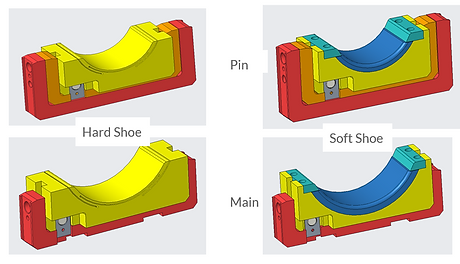
To reduce the high cost from lapper shoe (a part for a crankshaft machining machinery) changeover, our group proposed a solution to implement a quick change shoe with an adapter system that allows for the new shoe to be fully compatible with the existing machinery. The team delivered part files, drawings, and assemblies to the sponsor so that the parts could be manufactured locally. With the new design, the average changeover time decreased from 2 hours to around 10 minutes and helped to save thousands of dollar each year.
Cube Propulsion Device for Mechanical Design II
Jan. 2019 - May 2019
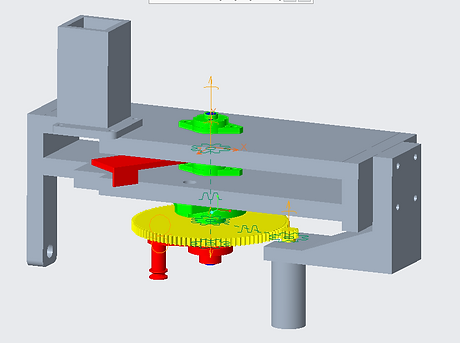
With only motor, 3D printing material, and rubber bands, we created a cube propulsion device that shot cube continuously. Our design comprises gears, half gear, bearings, and an interesting load and launch mechanism. Our group won first place among all the other 20 groups with the most consistent and most furthest shooting.
Grip Strength Testing Device
Jan. 2019 - May 2019
Existing research has found that grip strength can vary widely as shoulder, elbow, and wrist position changes. Our group was interested to test this theory by building our grip strength testing device. We constructed our device using a load cell with strain gages to measure the displacement of the beam, an operational amplifier to amplify the voltage signal, and MATLAB GUI to display real-time plot and data. After calibrating our device, we then conducted the test and we concluded that people tend to have larger grip strength when the hand is above their head.

Development of Neural Network Models for Current-Voltage Characteristics Prediction
Mar. 2018 - Dec. 2018
As an undergraduate researcher under Prof. Narayana Aluru's research group, I worked with Pikee Priya, a postdoctoral research associate, to develop a neural network for prediction of Current-Voltage characteristics when given a set of material properties. The normal way of finding those characteristics relies on a numerical model where transport and Poisson’s equations need to be solved and the whole process is extremely computationally expensive. Hence, by inputting enough data, a neural network could be trained, and the prediction of characteristics will be much more effective compared with the regular method. My main tasks were to gather all the data, determine the architecture of the network, train the network using supercomputer (BlueWater), and optimize the performance of the network. The final model was used to make numerous predictions with an average percentage of error around 2%.
